RealX is a tokenised real-estate platform. Each property sits in its own trust, split into ten thousand tokens. Investors verify once, buy tokens with the money held in escrow until the offer closes, and are paid their share of the rent every month. Sponsors run each property through their own portal; your operations team runs the platform through a console where every risky action needs a second person. We put your brand on it, plug in your sponsors and properties, launch it for you, and hand over the source.
The platforms that failed in this category failed on rent rolls, taxes and title, not on code. RealX makes the sponsor attest the rent roll monthly, pauses new offers when a report is late, reminds everyone when a valuation is due, and names a register break the morning it appears.
Investors verify once against identity, sanctions, tax and wholesale tests. Every order runs six numbered gates. Distributions, listings, forced transfers, rule changes and large withdrawals need a second person, and the audit log cites the approval behind each one.
Browse, read the documents, buy, get rent. Sign-in and the token wallet use a passkey on the device, so there is no password and no seed phrase. Payment advices and the annual tax statement are ready for the accountant.
Before RealX was designed, the five leading fractional real-estate platforms in each of the US, Europe, the Gulf and Australia were reverse-engineered: their legal wrappers, user types, flows, stacks and back offices. The pattern was the same everywhere. Tokenising changes the register, not the law.
Reg D, Reg S or Reg A+ offers; a transfer agent keeps the register; broker-dealer and ATS rules for any secondary market.
Outside MiCA; prospectus or crowdfunding regime depending on size; the DLT Pilot Regime for venues that want to trade it.
In Dubai, a VARA asset-referenced virtual asset carrying Land Department title; in Saudi Arabia, the registry's own tokenisation sandbox.
An AFSL-licensed trustee, wholesale tests until a retail launch, a client-money trust account. The demo is built on this wrapper.
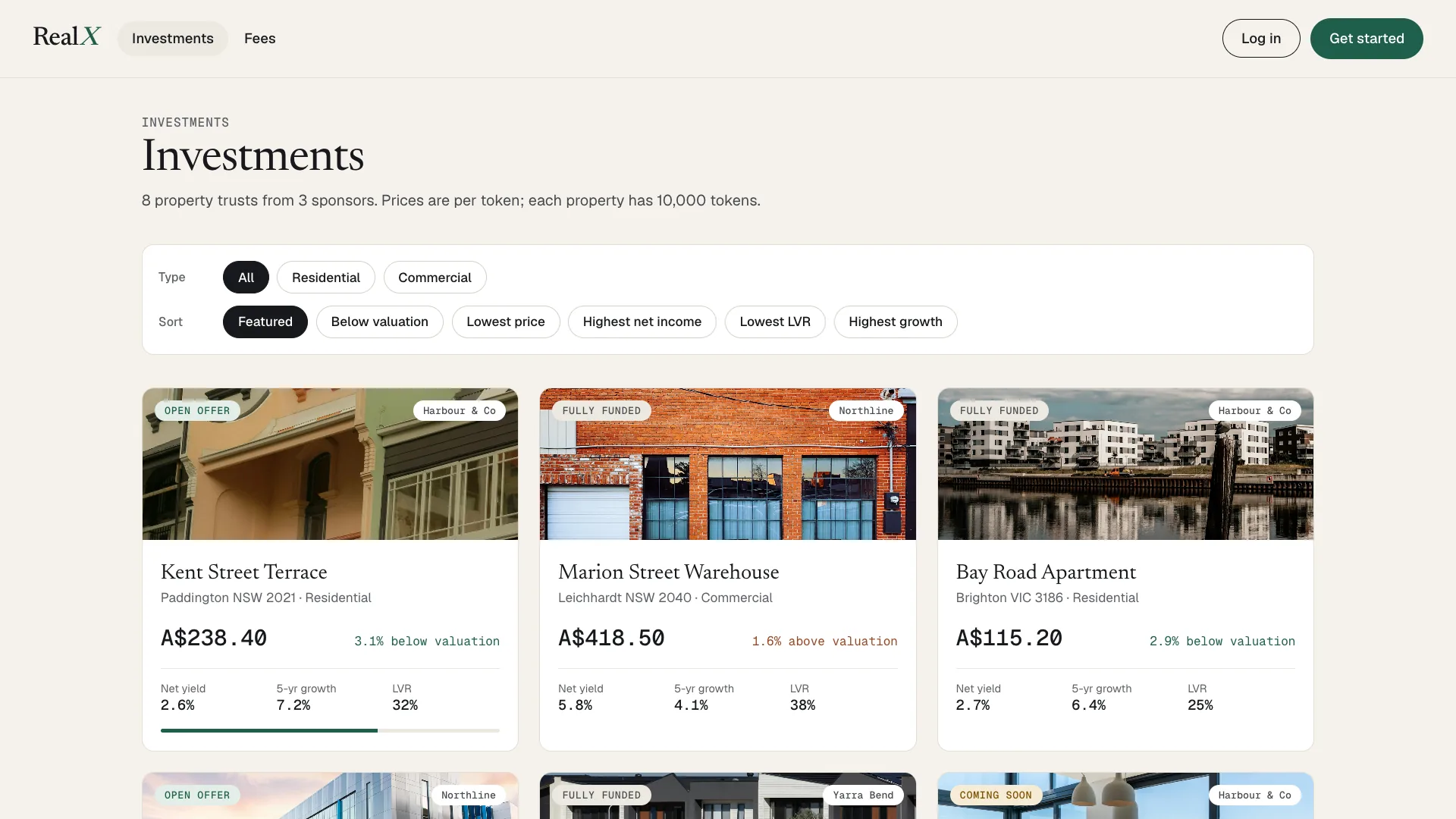
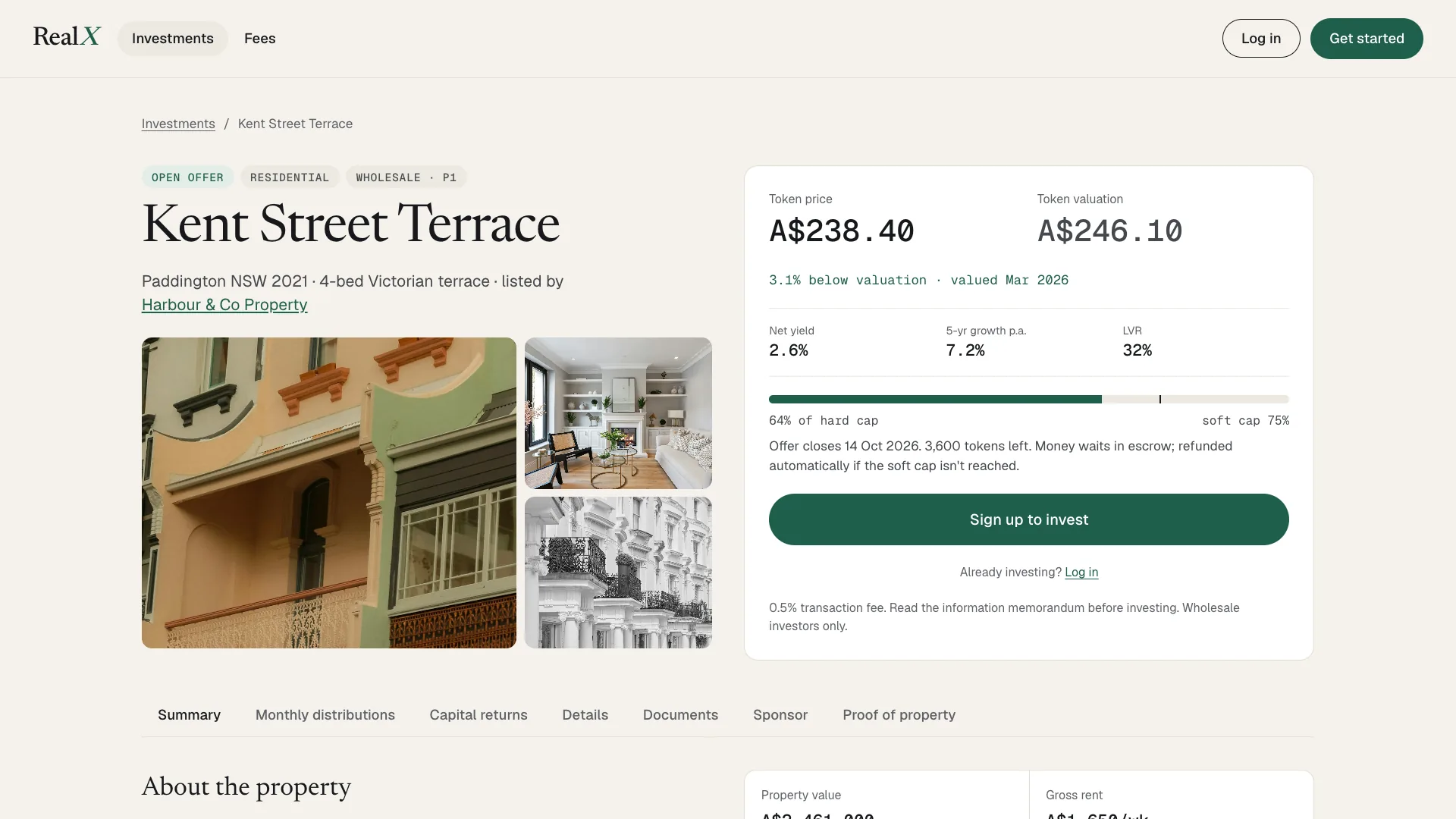
A listing shows the token price against the last independent valuation, net yield, five-year growth and loan-to-value ratio, then how far the offer is from its soft and hard caps and when it closes. Money waits in escrow until the offer closes and is refunded automatically if the soft cap is missed. Seven tabs hold the rest: monthly distributions, capital returns, trust details, documents, the sponsor, and proof of property.
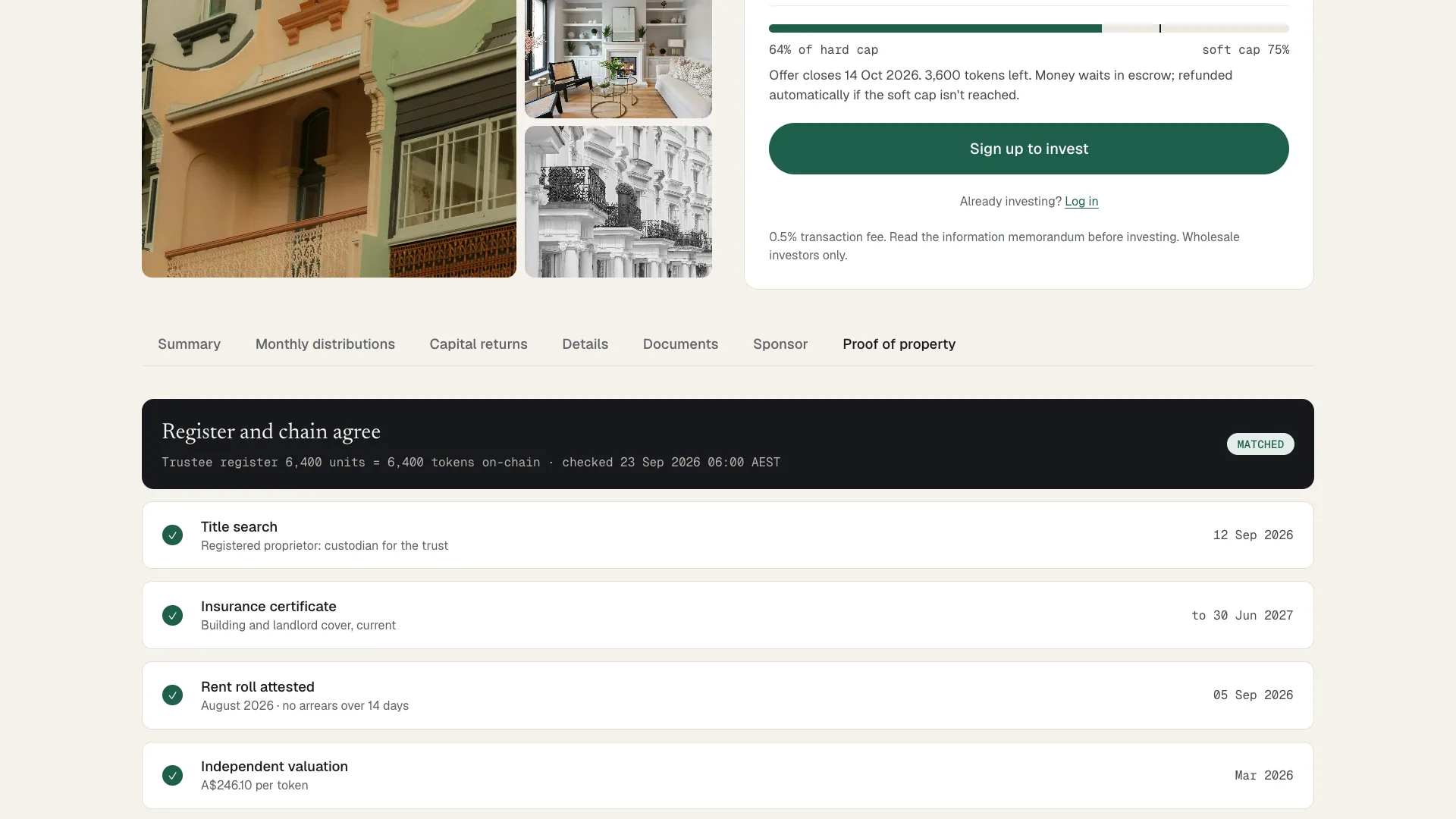
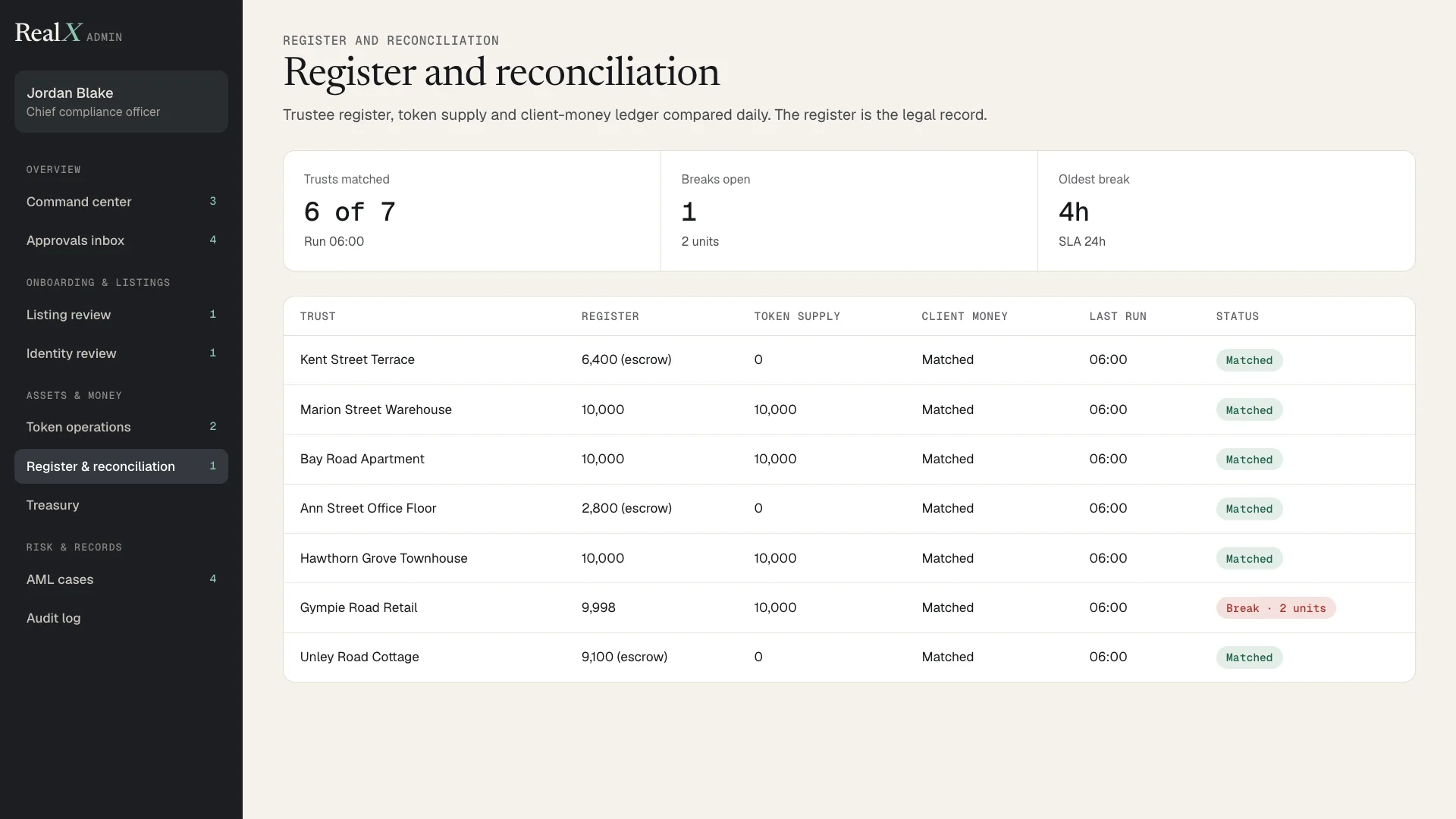
The trustee's register is the legal record and the tokens mirror it. Every morning the register, the token supply and the client-money ledger are compared for every trust, and the result goes on the listing: matched, or a break with its size. Beside it sit the title search naming the custodian as registered proprietor, the insurance certificate and its expiry, the sponsor's attested rent roll and the last independent valuation.
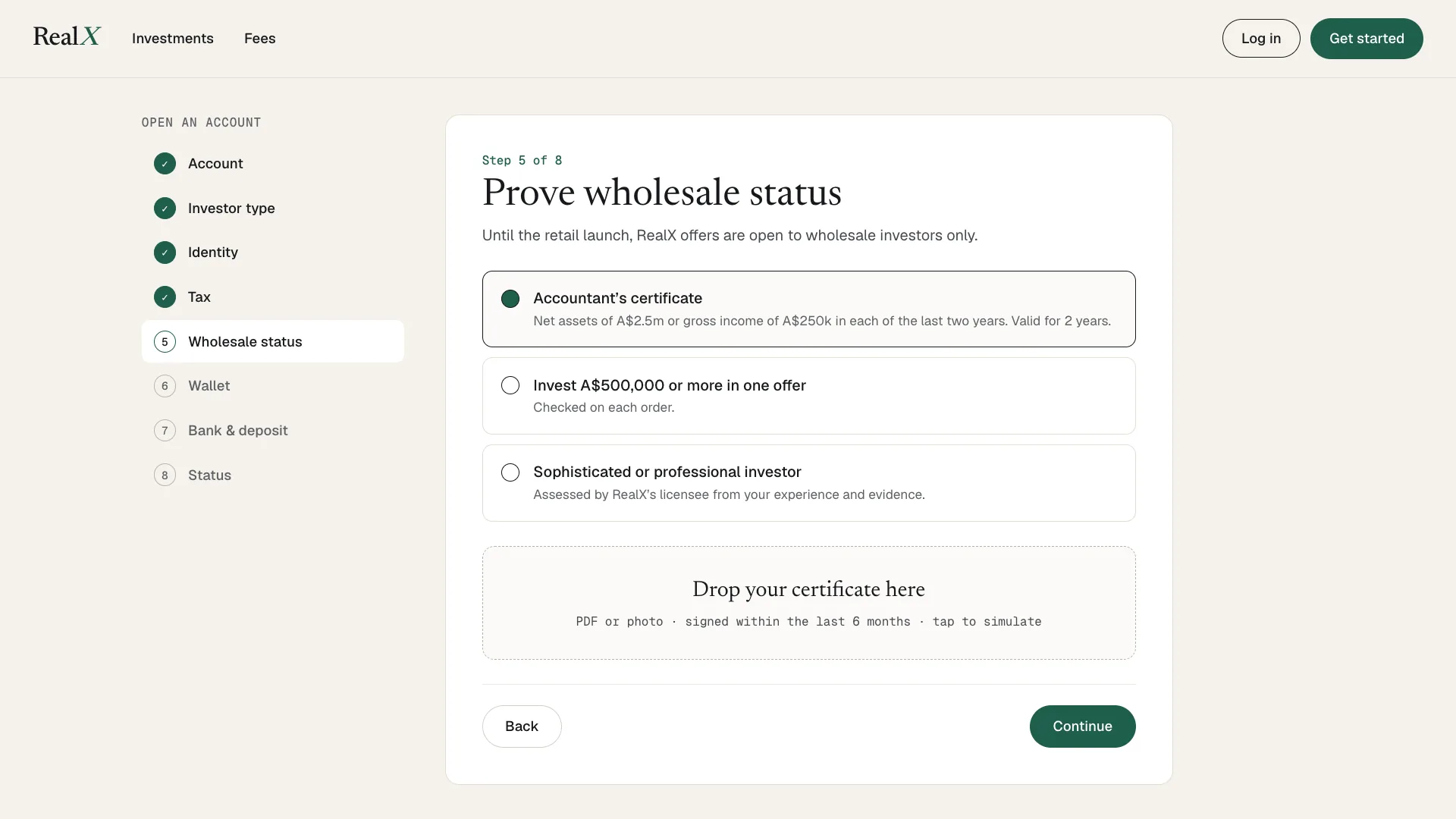
An email and a mobile, then who is investing: an individual, a couple, or an SMSF, company or trust where every trustee, director and 25% owner is verified. Identity is checked against government records with a liveness check against the licence photo. Tax details follow, then wholesale status by one of three routes, a passkey wallet with no seed phrase, a linked bank account and a first deposit. The result is one verified credential reused on every sponsor's offer.
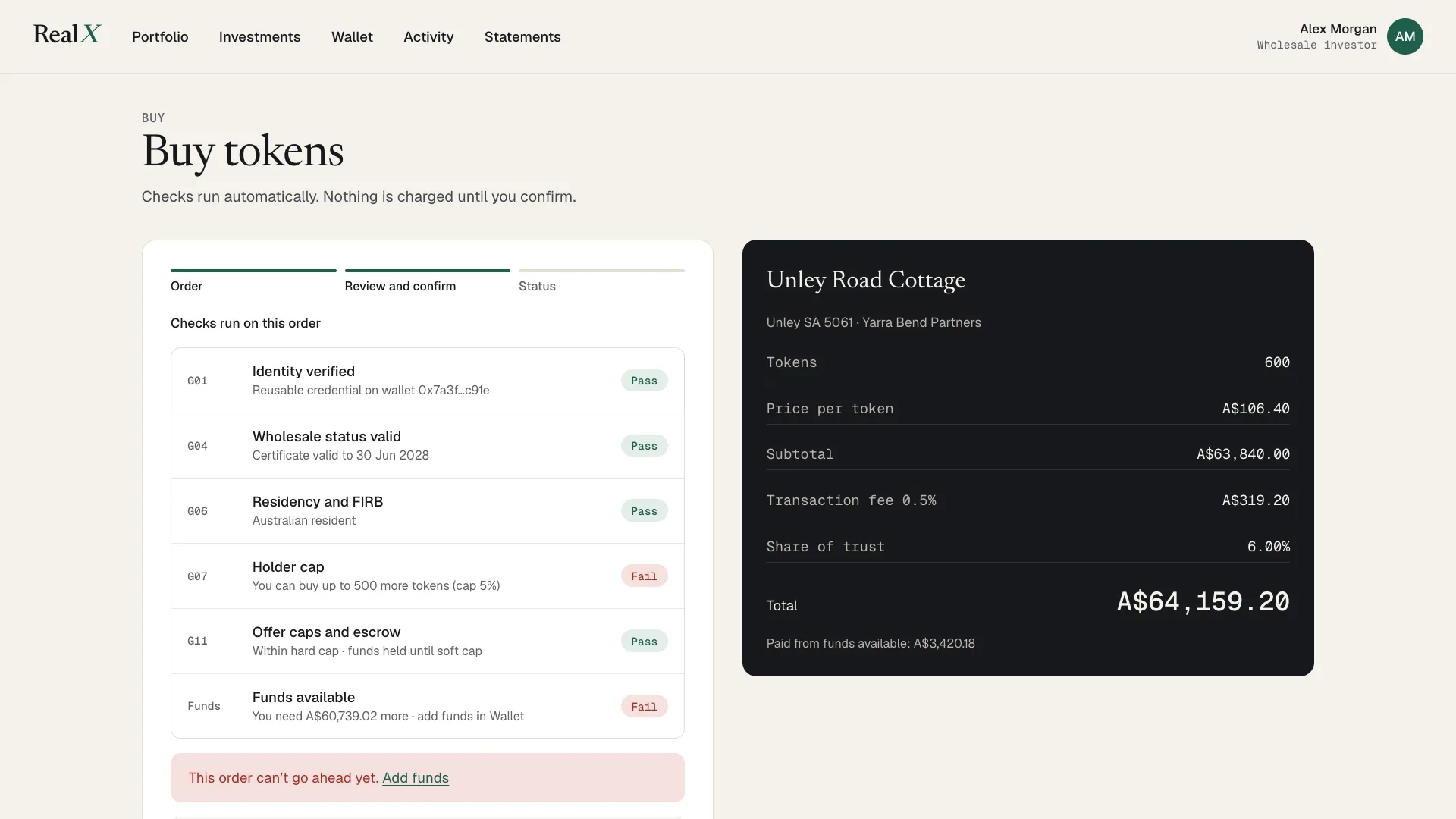
As an investor reviews an order, the rules run in front of them: identity verified, wholesale status current, residency and foreign-investment rules, the 5% holder cap, the offer's caps and escrow, and funds available. Each has a gate ID, a pass or a fail, and a reason. A failed check stops the order and says what would fix it. A passed order moves the money to escrow, where it waits for the offer to close and the trustee to issue the units.
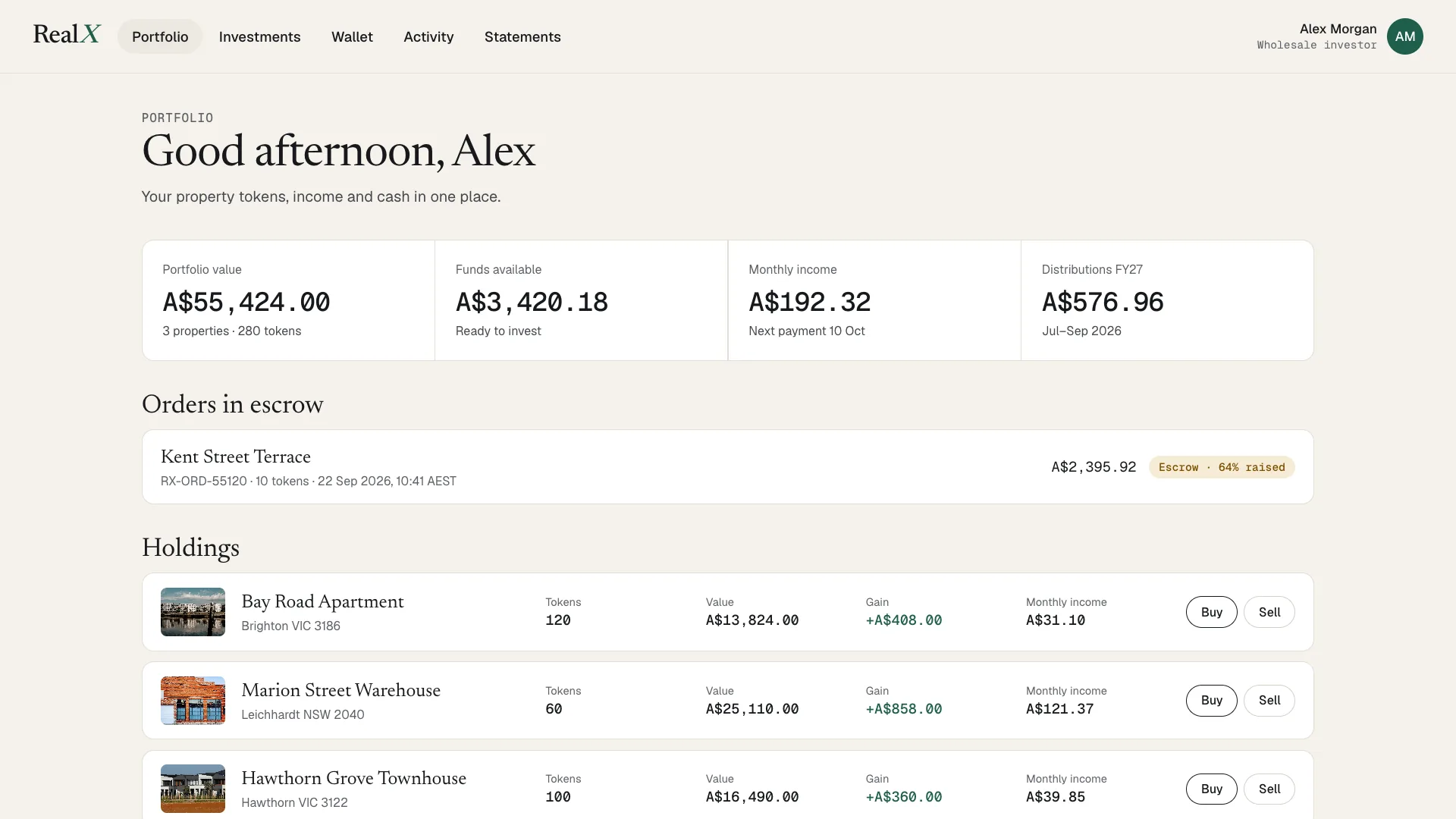
The portfolio shows every holding with its tokens, value, gain and monthly income, the orders still in escrow, and the next payment date. Cash waits in a client-money trust account until it is invested; a PayID deposit arrives in under a minute, and a withdrawal over the threshold needs a second approval from your team. Activity lists every order, deposit, withdrawal and distribution. Statements hold the monthly payment advices, trade confirmations and the annual tax statement.
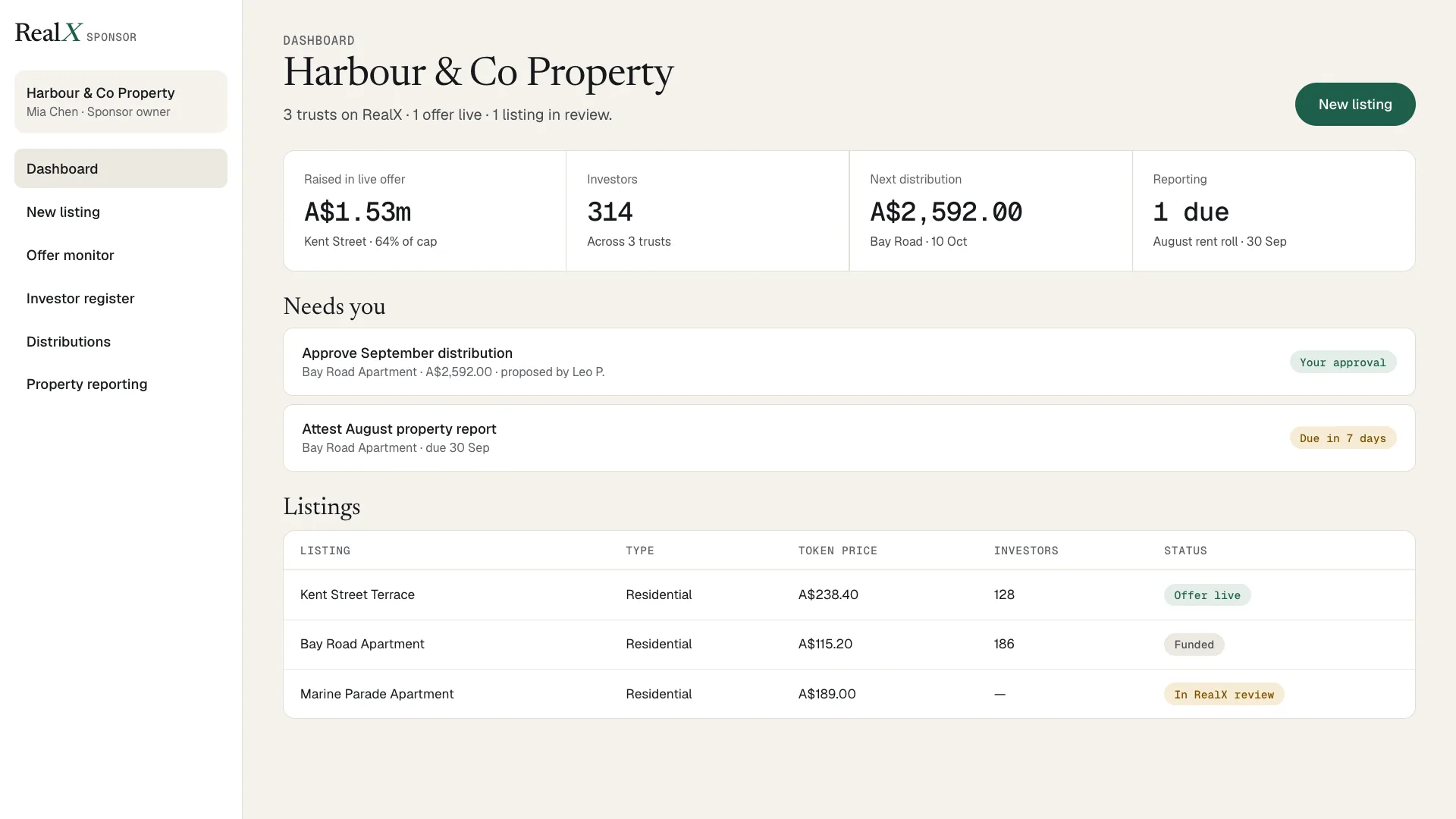
A sponsor is the company that owns and manages a property trust. Its portal opens on what needs doing: approve this month's distribution, attest last month's property report. The offer monitor shows applications as they arrive, money in escrow, the distance to the soft cap and the largest holding against the cap. The investor register mirrors the trustee's legal register. A new listing goes through due diligence, offer terms and documents, then to your team for review, and comes back with the changes requested.
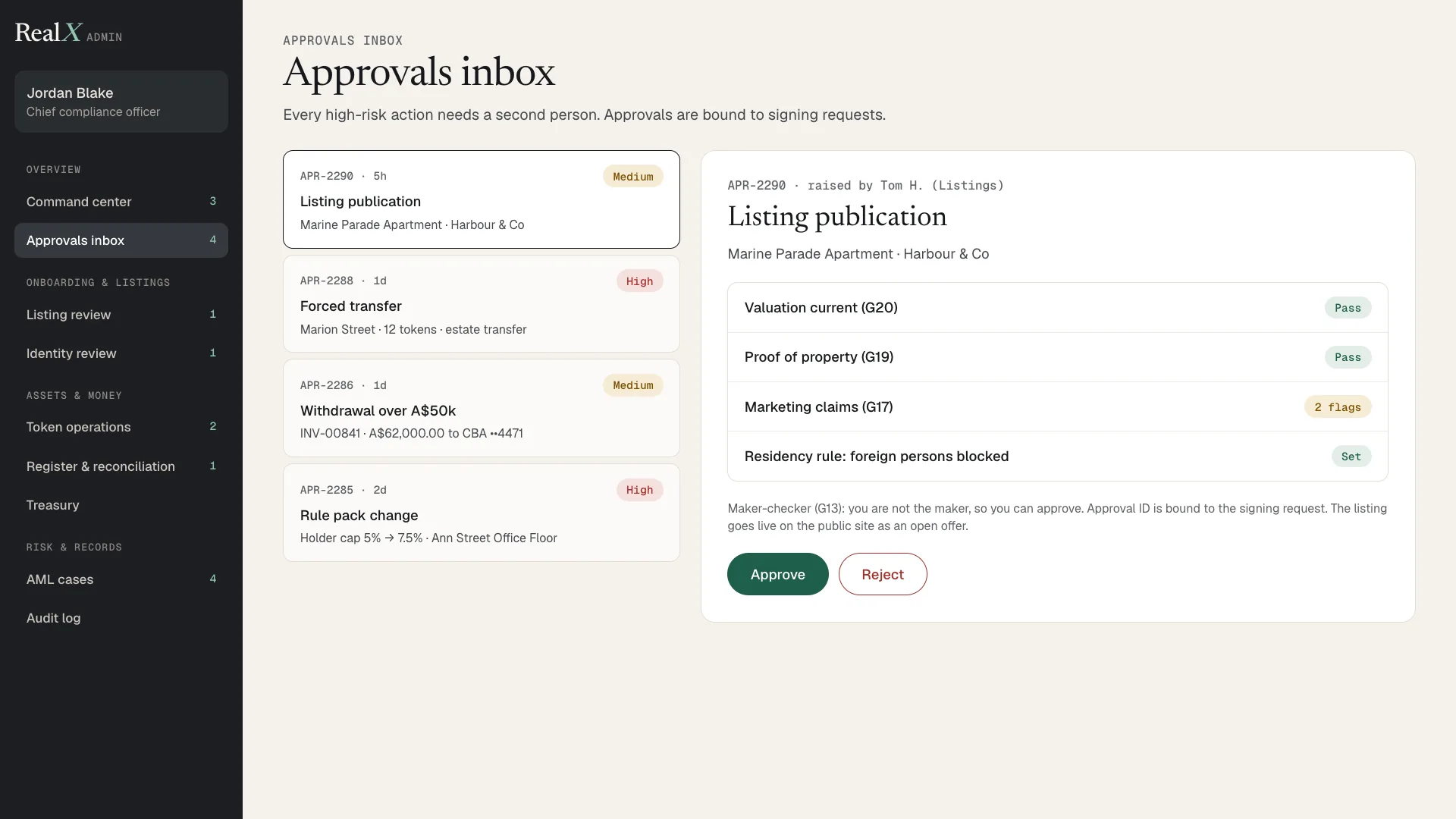
Your team signs in with a hardware security key to a command center: client money reconciled this morning, live offers, approvals waiting, open alerts. The approvals inbox holds everything that needs a second pair of eyes, each with its checks already run: a distribution run with the sponsor's approval, the attested rent roll, the holder snapshot and the cash to cover it; a listing with its valuation, proof of property and marketing-claim flags; a forced transfer with the grant of probate on file; a withdrawal over the threshold; a change to the rule pack. The maker can never be the checker.
Nothing goes on-chain without an approval and two of three custody signatures. Minting the tokens when an offer closes, a trustee transfer, a forced transfer for an estate, freezing a wallet on an AML case, pausing a trust: each is an operation that names its approval, collects its quorum, and is broadcast with the transaction hash recorded beside it. Every morning the trustee's register, the token supply and the client-money ledger are compared trust by trust, and a break is a named item with a size, an owner and a clock.
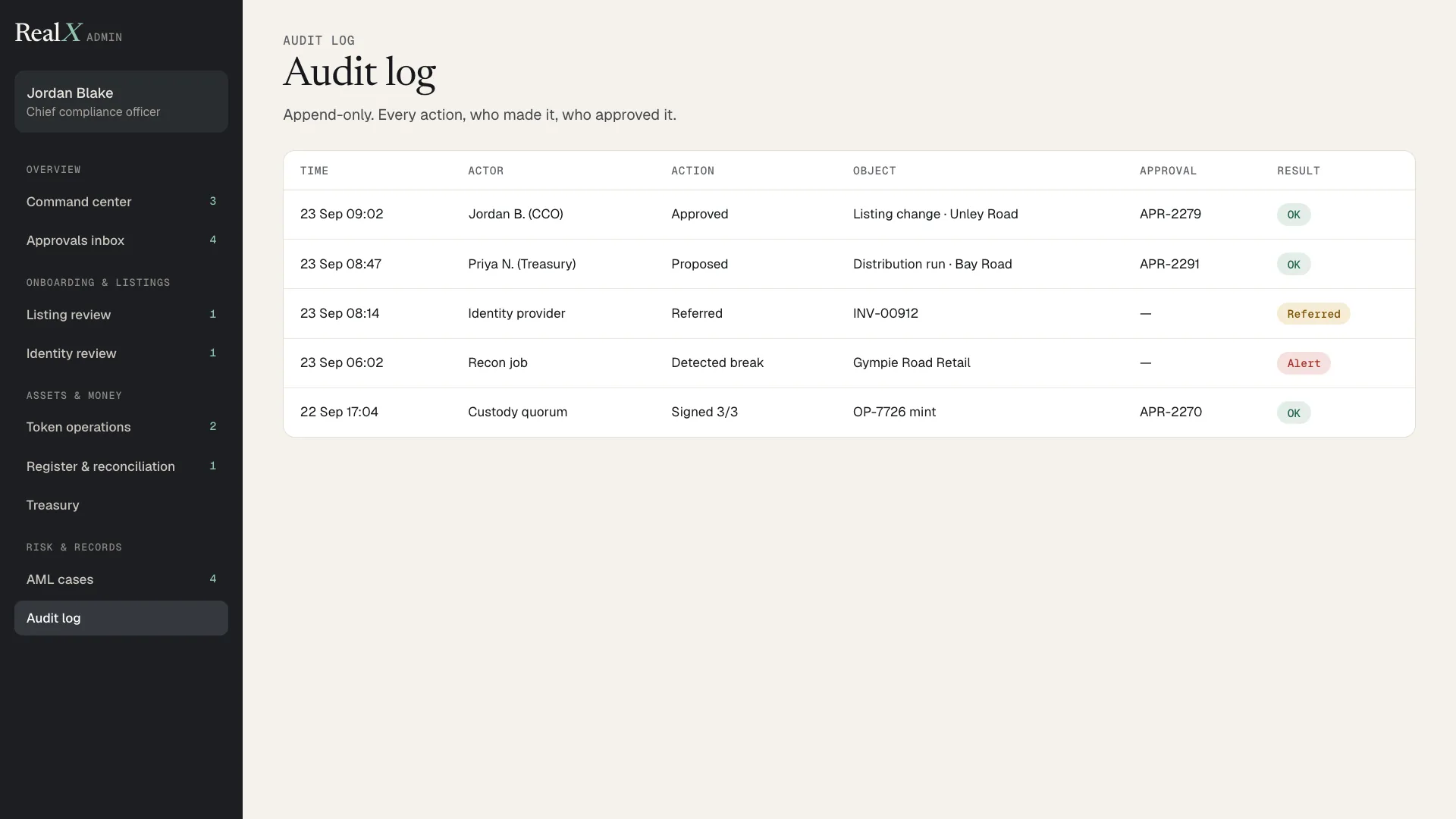
An investor's order, a sponsor's approval, your team's second approval, the custody quorum's signatures, the reconciliation job's break, the identity provider's referral: all of it lands in one log that cannot be edited, each line with its actor, its object, the approval ID behind it and the result. When a regulator, an auditor or a sponsor asks what happened, the answer is a filter, not an investigation.
The platform exists. The two weeks go on your brand, your sponsors and properties, your rule pack, and the vendors and keys that make it real.
Forty-five minutes with the engineers who will do the work. Your region and legal wrapper, your trustee and custodian, your first sponsors and properties, your fee schedule. You leave with the plan and a number.
Name, colours and domain. Your sponsors admitted and their first trusts entered with documents. Your identity provider, bank rail and custodian connected in place of the demo's simulations.
Holder caps, wholesale tests, withdrawal thresholds and residency rules agreed with your compliance lead. Roles and the maker-checker policy assigned. The reconciliation run against your trustee's register. Backups rehearsed.
Your first offer opens on your domain, with TLS, monitoring and backups, on your host or ours. Then the source, the docs and the keys.
The sponsor attests the month's rent roll, arrears, maintenance and insurance. The fund accountant prepares the distribution run: the amount and the rate per token.
The sponsor owner approves it in the portal. It lands in your team's approvals inbox as a high-risk item with its own approval ID.
The checks are already run: sponsor approval on file, rent roll attested, a snapshot of every holder, and client money that covers the total. A second person, never the maker, approves.
Every holder is paid at once from the client-money account. Each gets a payment advice; the activity feed, the statements and the audit log all read the same record.
RealX ships as the public site, the investor app, the sponsor portal and the operator console on one data model, with the rule pack, the reconciliation job and the audit log underneath. You get the stack, the tests that cover every cross-user flow, the research behind the design, and the plan for the integrations your region needs.
RealX is sold as a white-label installation plus the customisation that makes it yours. What that costs depends on your region, your vendors and what you want changed, so we give it to you in person: forty-five minutes with the engineers who would do the work, and you leave with a scoped plan, a two-week schedule and one number.
Bring your region, your first properties and your fee schedule to a launch review. You leave with a scoped plan and a number.